Showing posts with label conflict resolution. Show all posts

Monday, March 26, 2012

Bullying Academy


Recently, I received an email advertising the Bullying Academy.  This is a grant funded, web-based program for students in grades 4th-8th.  I decided to try it out with my 4th and 5th grade classes.  First, you have to register your school, and then each student registers and receives a user name and log-in.  For my first guidance lesson, I had time to explain what the academy was, help students log-in, and then take a "pre-quiz." The pre-quiz assesses what students already know about bullying.  That's as far as we have gotten so far, but myself and my students are very excited to pick it back up next week!

Once the students take their pre-quiz, they begin a series of lesson modules that include articles, information, and videos on what bullying is, why kids bully, what to do when someone is bullying you, and cyber-bullying.  The website has "follow along" worksheets for each grade level that the students can fill out while going through the lessons.  I know that this will be important for my students to ensure they read and not just skip to the videos!  After all the students have finished the lessons, there is a post-quiz to assess what they have learned.

My students are using Ipads to complete the Bullying Academy, and I think it will be a very engaging lesson and a new way of learning about bullying.

Wednesday, February 15, 2012

Put-up Messages

During No Name Calling Week I wrote a post on a classroom guidance lesson where I had the kids write Put-up messages to each other. I wanted to show you the bulletin board I made to post their messages on.  The students love it because they get to search for their name and kind message, and I love it because the whole school can read 100 examples of Put-ups! :) It's a win win.


Thursday, February 2, 2012

Take A Stand: 5th Grade Bullying Lessons

To capture my students’ attention at the beginning of the lesson, I had them pretend that they were doctors (or counselors) and I was a 5th grade girl who was coming to see them because I’ve been so sad lately.  I said, “You know when are sick or having problems you go to see a doctor or a counselor? Well, today, I’m going to be the 5th grader and you are going to be my doctor. So pretend that I have just come into your office and sat down and you ask me what’s been bothering me.  Once I tell you what’s wrong, your job is to sort through everything you hear and tell me what you think is causing my problems.”  They were all very excited to be my doctor! J  Here is what I said:

“My name is Abby and I haven’t been feeling good lately.  I don’t want to go to school or even play in my basketball game on Saturday.  I have to go to my dad’s house tonight but I don’t want to.  He doesn’t understand any of my problems. This weekend my friends are having a sleepover, but I probably won’t even get an invitation, because last week at lunch everyone was having fun and all I wanted to talk about was my dog that died.  All in all things just aren’t going well at all!”

Then, I asked students what they thought the root of my sadness was.  Most students thought Abby was sad because her parents were divorced and her dad didn't understand her, her dog died, her friends weren't going to invite her to their sleepover, etc...They were a little surprised when I said, "Yes, those are all things that usually really upset students Abby's age, but in her case the thing that was bothering her the most was that other kids at school were calling her names everyday and bullying her.  This is why she didn't want to come to school anymore."  I explained to my students that in this "case study" Abby had serious problems, but none of them were more serious than being a victim of bullying.  I think this helped them think of the effects of bullying in a different way than they had before.

Next we did an activity from the "No Name Calling Week" lesson plans, called Response Cards. Each student got a copy of these cards and cut them apart:
Then, we talked about ways to "take a stand" and who to "ask for help." I read them a couple bullying scenarios from the lesson plan and they held up which option they would do in that situation and we discussed each one as a class.  

In my next lesson, students chose a typical bullying scenario and drew rough drafts of "Bully Comic Strips."  I got the idea from this lesson in the "No Name Calling Week" plans.  They had 4-6 blocks for their comic. The first box set up the setting for their bullying scenario and the second box included the bullying.  In the third box the students were to illustrate a character either taking a stand or asking for help.  And, in the fourth box, they drew the conclusion.  We used Lego Comic Builder to create our comics. Here is my example: 


Monday, January 30, 2012

No Name Calling Week

Last week was officially "No Name Calling Week," or as my students like to call it, "No Bullying Week." What better week to begin my bullying unit?!  I thought I would share some of my ideas with you. I got a lot of my resources from http://www.nonamecallingweek.org/cgi-bin/iowa/home.html. They provide a teacher guide, parent letters, school-wide activities, and more.

Classroom Guidance Lesson for 3rd grade
Today, we read Simon's Hook: A Story About Teases and Put Downs by Karen Burnett and talked about what to do when someone is teasing you or calling you names.
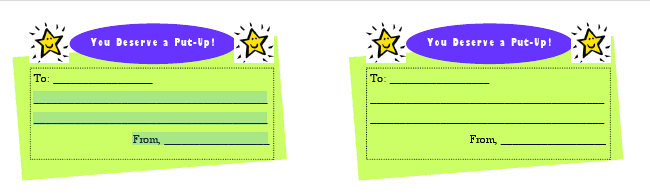
I picked this book specifically for No Name Calling week, but also because I know of some current friendship concerns in 3rd grade.  My hope is to give the students who are being picked on some confidence and some tricks to "pull out of their bag" when their classmates are being mean to them. Also, as a way to encourage more positive behavior, I had each student pull another student's name out of a cup and had them write a "put-up" message to that person. We talked about what a put-up is and brainstormed ideas of nice things to say to each other. I made sure to tell them to tailor their put-up message specifically to the person's name they drew so we didn't get lots of general put-ups like, "you're nice" and "you're a great friend."  I created this document and printed it off on label paper so that I could stick the put-ups up on a bulletin board.  Then, as the students walk by the board they can search it for the put-up written to them and hopefully it will brighten their day :) not to mention provide a visual of hundred of examples of put-ups.

Next week, I plan on showing these 3 videos to review Simon's Hook and remind students how to "not get caught by the bully's bait!"

Check back tomorrow for No Name Calling Week ideas to use with 5th grade and 4th grade! :)

Tuesday, November 1, 2011

Conflict Resolution Vokis

In guidance classes, students have been learning about effective conflict resolution skills.  They have learned to use "I" Messages when someone is doing something they don't like.  "I" messages allow students to express their feelings and to be assertive with students who are not treating them positively. 

I recently came across this awesome website: www.voki.com.  Using free trials, students can search through many different characters including animals, political icons, randoms, and other people and add accessories, backgrounds, and speech.  I let my 5th grade classes play around on this website and create a character for their conflict resolution project. Using a "text to talk" function online, each voki gives advice to a hypothetical student who is a concerned bystander to bullying.  Students were asked to created a "voki" character that answered this prompt....

"Hello, This new kid moved into our neighborhood.  He's from a different country, and he doesn't speak English very well.  Some other kids are calling him names and making fun of his clothes.  I wish they'd stop it.  What can I do?" (from Treat Me Right, Kids Talk About Respect by Nancy Loewen)

Click the links to view a couple Vokis the students created: